Mentorship within medicine is highly variable and lacks consistency and structure. The idea of MENTORx came about naturally, and the more we thought about the problem and discussed it with our friends and coworkers -- it became clear that this is not a unique issue just to us. During this post, I will try to explain and illustrate the problem that we're trying to solve for. I will use my personal path into medicine as an example to make some of my points and to illustrate the implications of what some of this means . I also want to acknowledge my privilege early -- to be born into a family that valued education and encouraged me to pursue this journey at just about every step of the way.
The facts:
To succeed in the field of medicine, mentorship and guidance is crucial.
It is often extremely difficult to access mentorship and help while moving through the medical pipeline, and people fall by the wayside.
Going WAY back - I grew up in a tiny town in Alaska called Talkeetna. With a year-round population of ~900 (up to a whopping 1055 in 2020 census), I went to a public school that served three different communities (Talkeetna, Willow, and Trapper Creek). As far as I can tell or remember, only one person prior to me in the history of my high school had ever gone to medical school and become a doctor. While I was extremely lucky to have supportive parents that always valued my brother and I getting an education, the thought of becoming a doctor was quite literally never in my mind as a kid. I took science classes and all of the required other classes, but nothing really stood out. My mother was a Physician Assistant (PA-C) and made an enormous impact on our community, serving as a the primary caregiver for our community while working at the Sunshine Clinic, our local community health center.
The first time I thought about going to medical school, I was a second year in university. Even then, I felt like I was already set up more than many people, just because I had been lucky to choose a school that had a large cohort of "premed" students. I knew NOTHING about medical school. I barely knew the difference between PA school and medical school at this point, to me all I really thought about was that it would be basically impossible to apply to med school and I had no idea where to start. My undergrad degree was a Bachelors in Science in Kinesiology -- why had a I chosen this? Because I was obsessed with martial arts and fitness, and it was the only thing I found even remotely interesting to study. As I started my second year and took a musculoskeletal anatomy class, I was struck by how I actually was excited to study for once. Similarly with my basic physiology class. These two classes, for better or for worse, set off a series of events that turned me towards medicine. But where did I start? I knew zero doctors, had never shadowed, didn't know anything about GPA requirements or the dreaded entry exam (MCAT) that my classmates were already prepping for.
Let me briefly stop to contrast this experience with one of my McGill classmates, let's call him "Kenny". He grew up in urban Canada, both parents were doctors, and he had completed a pre-med prep school experience before even setting foot on campus for his undergrad. I remember asking him about medical school, and as he gave me a helpful overview of what was required, I felt a huge pit in my stomach. Years behind, and I had barely even started.
This pit in my stomach only got worse as I hopped on to the internet to try and scrape together a plan. Reddit, a wealth of information delivered via anonymous contributors with intermittent community moderators, made it clear that my prognosis was grim and I would likely not have a chance. StudentDoctorNetwork (SDN), a more niche forum page, was even worse. My first post gave a quick background of my life and educational experience including GPA, coursework, etc. and queried a simple question -- do I have a chance? I'll never forget the first comment: "no, you will not be a doctor, I'd recommend physical therapy or something less competitive". No joke. The next thing I did was salvage what I could. I spent a few thousand hard-earned bucks from my summer fishing job and dumped it into a Kaplan MCAT course that I subsequently got destroyed by. Knowing zero doctors, I sent out 50 desperate letters to doctors offices trying to find shadowing opportunities, of which one cardiothoracic surgeon responded (likely out of pity). Coming back to third year of undergrad, it truly felt unattainable. I scrapped together an MCAT score that was slightly better while studying full time, and started getting my application together. My classmates did "med school consulting" courses which I felt envious about, but could not afford the $4000 package fee.
Fast forward, by some combination of luck and late nights working my ass off, I was accepted for med school. Being from Alaska, I was extremely lucky to get a spot back in Anchorage despite being a less than stellar applicant, as they were really trying to matriculate real Alaskans as part of their WWAMI program. Starting med school after going to a rigorous university, I finally felt like I wasn't completely behind when it came to studying patterns and physiology/anatomy knowledge.
BUT GUESS WHAT I WAS NOW BEHIND ON?! What specialty was I going to do? Surgical or not surgical? Procedural? Did I want to outpatient or inpatient? Academic or community. It felt like I was starting this same cycle again - behind before I had even left the starting line. Surrounded with med school classmates that had grown up with surgeon parents, OBGYN siblings, or research exposure that had narrowed their specialty interest, I felt like I was starting from scratch. My first and second year, I had no idea where to start. I remember saying "there's no way in hell I'd be a surgeon". At this point, it became clear that mentorship would be somewhat easier to obtain, but I felt that as a first and second-year pre-clinical student, I had minimal exposure to residents or attendings in various specialties other than our professors who were all PCP docs. Starting clinicals, it became slightly easier to interface with attendings and ask some questions, but I still felt like I was bothering them by asking to meet or discuss. I'm a pretty outgoing guy, but it just felt like I was nagging them. I struggled for a long time to make my specialty decision and I had essentially no strategy towards finding and matching into a competitive specialty. It was trial and error, even more Reddit sweating with the addition of Google "Residency Sheets" (a great resource, but a huge source of anxiety). As I discussed in my other post, this ultimately manifested in a very delayed final decision as to what I was going to specialize in.
Now, as a newly minted chief resident, I see the same problem repeating itself. Once again, I'd be remiss in not acknowledging how privileged I am at this point -- I grew up with family that cared about education and had the means to encourage me to succeed in high school and university. It's not always like that. But I work with medical students and residents that have almost all experienced at some time or another the feeling that they were either a) alone in the process, b) behind their peers, or c) unable to find the mentorship they needed. Some schools have very good mentorship tracks and pathways - but what about coming from a small school? What about a liberal arts college without a premed track? What about a rural or urban setting with no infrastructure to support scientific endeavors? What about those with no medical interfacing and no family to help them navigate it?
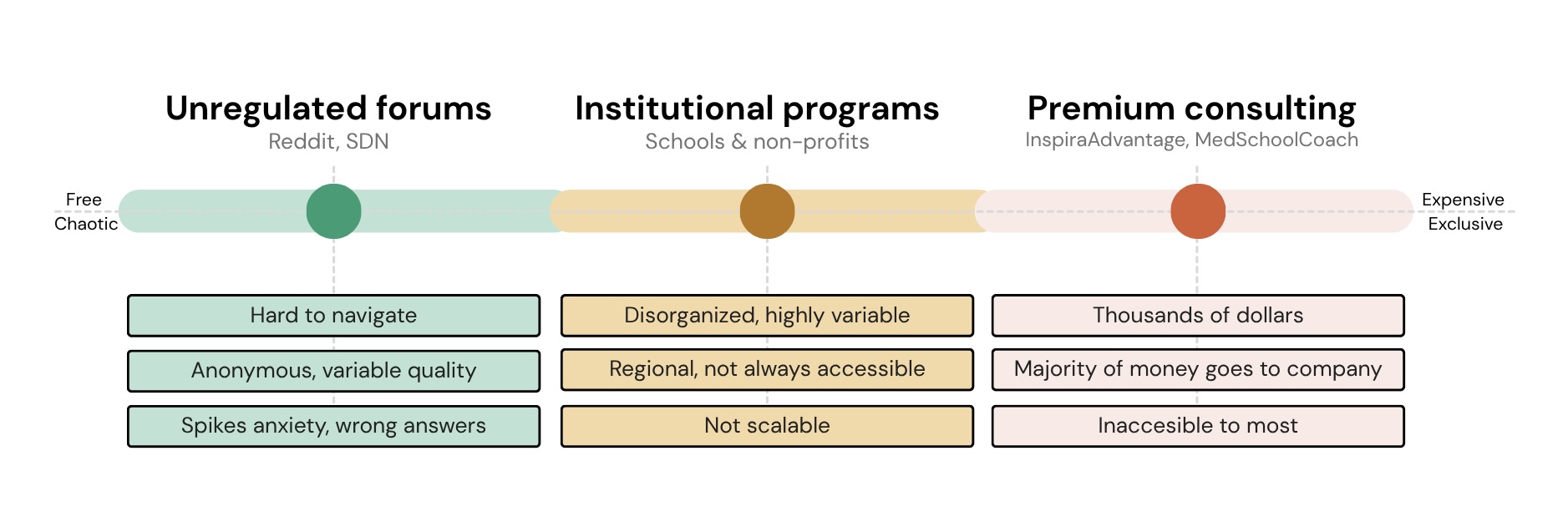
The answers that currently exist run as a spectrum. On one end, you have largely unregulated, anonymous information delivered through forums such as Reddit or SDN. These can be extremely helpful, but are more difficult to navigate and can often spike cortisol and lead to unanswered (or even worse, incorrectly answered) questions. In the middle, you have highly variable organizations either arranged through individual academic institutions or various non-profits; these tend to be not well organized and regional, but more than anything - they aren't scalable. On the far end of the spectrum, you have huge companies that charge thousands of dollars for medical school or residency consulting. They facilitate application review and feedback, mock interviews, tutoring for specific exams (MCAT, USMLE, etc) at premium prices (think $100-300 / hr...). And that money is largely going into the pocket of the company rather than the supply they are using (residents & med students, usually).
We're hoping that MENTORx will serve as a happy medium. A platform that is regulated, with vetted mentors that are wanting to interact with mentees in order to help them strategize and improve the journey. Talking with someone a step or two ahead of you can be hugely helpful, especially within medicine. We are going to keep trying to have more Q&As with real answers from real people in the field (not nameless/faceless people on forums). All of our mentoring and strategy sessions are either free or low cost, and it's fully up to the mentor what they want to do. For anyone who can't afford to pay for any of this - there are free options. For people who feel comfortable paying for certain services (strategy, mock interviews, application reviews, etc), you can do that and that money goes directly to the mentor for their time minus a small fee to help fund the platform.
- CIA
Want personalized guidance?
Book a 1-on-1 session with a med student or resident mentor.
Browse Mentors →